
 Mattress Reviews
 Best Mattresses
 Compare Mattresses
 Accessory Reviews
 Sleep Science
 Sleep Disorders
 Sleep Tips
 Health























For teens around the country – and especially those in California – the morning bell is no longer ringing quite as early. It’s a change that’s supported by decades of research and backed by the American Academy of Pediatrics, American Medical Association, and many others.
The rationale? Too-early start times, which cut into adolescent sleep, are a major contributor to chronic sleep deprivation.
Making the Shift in California
Even so, switching to a later schedule still requires some adjustments.
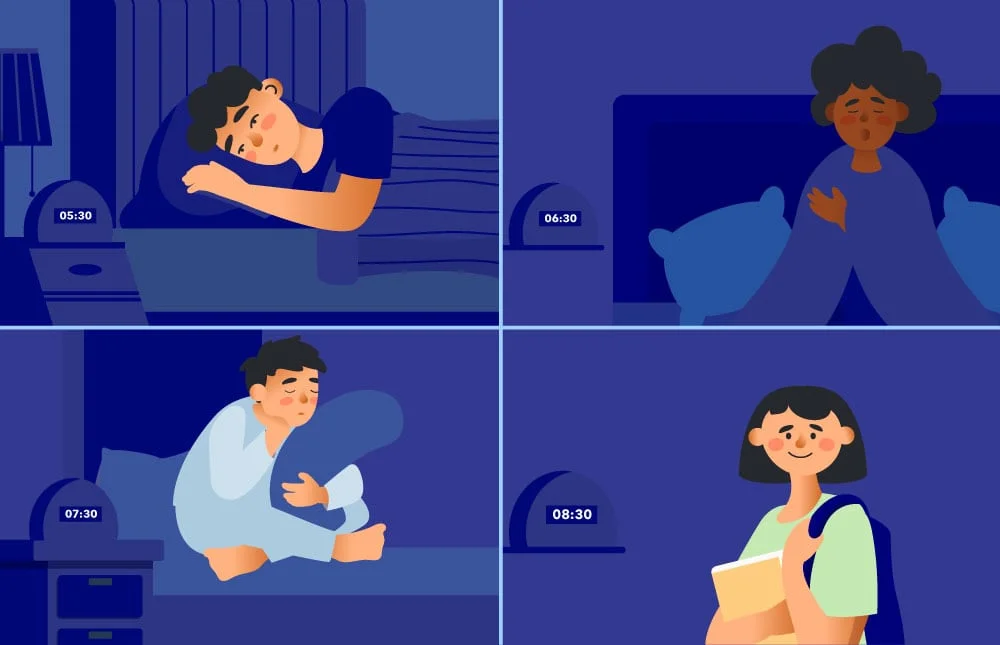
For Anita Hernandez, who works as a school counselor in the Fresno Unified School District, the 2022-2023 school year brought later start times for her two sons, thanks to a new law that went into effect in California last July. That law – the only one of its kind in the nation – requires start times of 8:30 a.m. or later for the state’s public high schools and 8 a.m. or later for its middle schools. The law has spurred similar active bills in several states, including New York, New Jersey, and Texas.
Despite the later start times at both of her sons’ schools, Hernandez, who works in the district office (rather than at a school site), still has to be at work by 8 a.m.
This means that her son Aiden, a freshman at Fresno’s Patiño School of Entrepreneurship, gets dropped off about an hour before his high school’s 9 a.m. morning bell.
Even so, he’s still a fan of the later start time, which allows him to sleep until 7:30 a.m. As an additional benefit, “it gives me time to socialize more in the morning,” he says. “I don’t have to go straight to class when I get there.”
For his older brother, Lucas, the later start time is also a positive, although with caveats. Lucas is a junior at nearby Clovis East High School, which used to start at 7:40 a.m. This year’s shift to an 8:30 a.m. morning bell means he now gets about 30 minutes’ more sleep.
For him personally, it’s a net positive. “I’ve never really been a morning person,” he says.
But for some of his friends, especially those who play sports, the shift wasn’t a welcome one, given the correspondingly later end time for after-school practices. “People don’t like going home later,” Lucas told Sleepopolis. “The problem [for them] isn’t school starting at 8:30; it’s school ending at 3:15.”
Feedback from his friends on whether they’re getting more sleep has been “mixed,” he says. But for him, the later start time has helped offset his later bedtimes this school year due to his increased homework load as a junior, which includes AP chemistry.
The Case for Later School Start Times
Teens like Lucas may be up late because of homework and other activities, but there’s also another factor at play: the circadian rhythm shift that takes place during adolescence. This shift means that they’re not feeling sleepy until later at night and are also predisposed to sleep later in the morning than they once did.
When they attend schools that start too early, they’re forced to wake at a time that’s not in sync with this – and one that all too frequently means they’re not getting the recommended 8 to 10 hours of nightly sleep. In fact, according to the most recent data from the Centers for Disease Control and Prevention (CDC), only 22 percent of high-schoolers reported getting at least eight hours of sleep on a school night.
That’s a major driver of teen sleep deprivation, which impacts graduation rates, mental health, car crashes, and more.
Repeated studies have shown that shifting to later start times improves student sleep. In the Seattle School District, pushing back high-school start times from 7:50 to 8:45 a.m. netted a 34-minute gain in median sleep duration. And in Cherry Creek, Colo., researchers found that shifting the start time from 7:10 to 8:20 a.m. meant that high-school students were able to get an additional 45 minutes of sleep.
Adjusting to the Change
In Madison, Wis., pushing back school start times was a multi-year process that included altering bus schedules, as well as adjusting elementary school start times.
For Jennifer Rosen Heinz, a local parent who advocated for the change, the wait was worth it. Rosen Heinz had been spurred to action by the 7:35 a.m. start time at her son’s middle school. He would “basically sleepwalk to school,” she told Sleepopolis.
Although the later start times didn’t take effect during his middle-school years, his sibling, who’s now an 8th-grader, has benefitted from the new 9 a.m. start time.
That’s translated to a wake time of 8 a.m., Rosen Heinz says – a marked change from the 6:20 a.m. wake time during her eldest’s middle-school years and the ripple effect it had on their household. Her son’s alarm clock used to wake up everyone except for him, she reports: “We would hear it rattling through the walls, but he’d sleep through it.”
By contrast, “mornings now are so much calmer, so much more pleasant,” says Rosen Heinz. Her middle-schooler even has time to shower and eat breakfast before leaving the house at 8:40 a.m.
In Hernandez’ household, mornings are also a bit less rushed, she says. Her high-schooler, Lucas, now has time most days to pick up a grab-and-go breakfast at school, which gives him a bit more time at home for sleeping in or getting ready. “He never benefited from [the school breakfast] in the past,” she says.
While there was a bit of an adjustment period to the new schedule at the beginning of the school year, “it didn’t last that long,” Lucas says. “It was really only like a few weeks, and then I got used to it.”