
 Mattress Reviews
 Best Mattresses
 Compare Mattresses
 Accessory Reviews
 Sleep Science
 Sleep Disorders
 Sleep Tips
 Health

















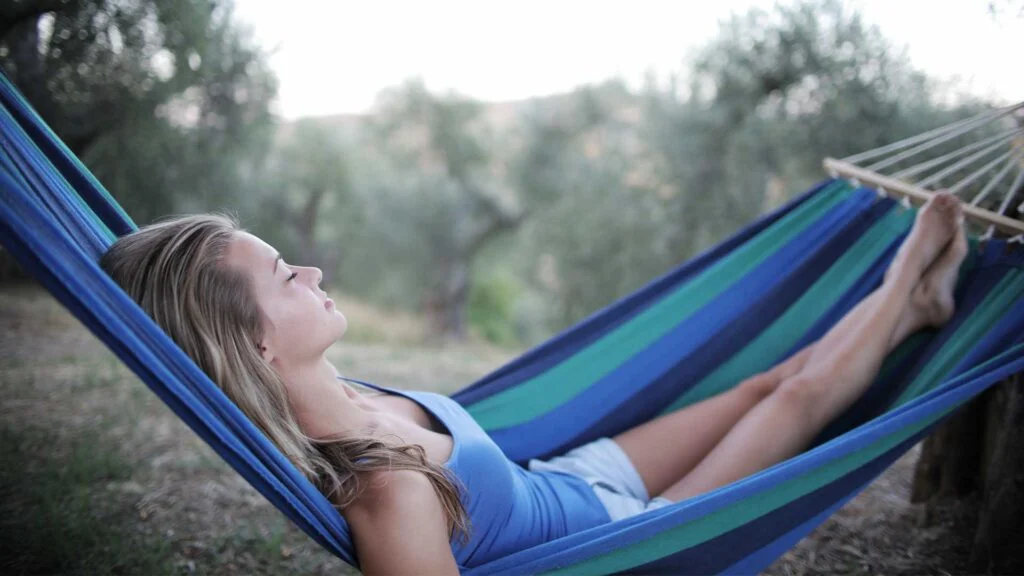
If you struggle to get enough quality sleep at night you’ve probably tried multiple methods of making your bedroom darker, quieter, cozier, and more relaxing. But the quickest path to good sleep might not be inside your house—you might find a more restful, invigorating night of slumber out under the stars. A study from 2017 found that one surprising method for banishing sleepless nights is moving from sleeping indoors to the fresh air of the outdoors in a camping tent or hammock (1). To find out why, we dove deep into the research on why sleeping outside might be so beneficial.
Note: The content on Sleepopolis is meant to be informative in nature, but it shouldn’t be taken as medical advice, and it shouldn’t take the place of medical advice and supervision from a trained professional. If you feel your child may be suffering from any sleep disorder or medical condition, please see your healthcare provider immediately.
Long Story Short
- Sleeping outside can help balance your circadian rhythm, making it easier to fall asleep and wake up in the morning.
- Limiting your exposure to artificial lights can help support melatonin production.
- All that fresh air may have a positive effect on your immune system, in addition to other health benefits like improved cognition.
- It’s important to consider both safety and comfort when sleeping outdoors, which means planning ahead and packing properly.
Natural Light Exposure Resets Your Circadian Rhythm
While studies on the benefits of sleeping outside are admittedly limited, there is plenty of research into the effects of light on the circadian rhythm. Our 24-hour internal clock is heavily influenced by light and dark. During daylight hours, alertness peaks. When it’s dark out, we’re primed to sleep.
According to one study, the availability of artificial light indoors has changed the natural light environment, which can throw off the proper functioning of oura circadian rhythms (2). Sleeping outside, however, sidesteps the issue since there’s no nighttime artificial light to keep you up when you should be asleep. One older study from 2013 found that exposure to only natural light causes the circadian rhythm to synchronize to solar time (3). In other words, sleeping outdoors and waking up to the brightening sunlight is the most natural way to awaken—and can result in greater alertness and less grumpiness in the morning.
Lack of Indoor Lighting Helps Melatonin Production
Whether you’re streaming just one more episode or reading one last chapter of your favorite e-book, evening exposure to the blue light emitted by electronic devices can set you up for a restless night. A clinical review from 2022 found that exposure to blue light can decrease sleep efficacy and quality. (4). By sleeping outside (and limiting your screen time!), you avoid exposure to both artificial lighting and blue light that could inadvertently be suppressing the melatonin production you need to start feeling drowsy.
Potential Increase in Immunity Levels
Sleeping outside exposes you to fresh air—and if you’re in a forested area in particular, that can be a really good thing. Research has shown that the chemical that plants give off to protect themselves, phytoncides, can also protect humans. These compounds have antibacterial and antifungal qualities, and they trigger an increase in white blood cells (5). The Japanese discovered this long ago and even have a name for it: shinrin-yoku, or forest bathing.
According to one study, forest bathing could also help improve cardiovascular function, alleviate anxiety and depression, and significantly improve people’s emotional state and attitude, among other benefits (6).
Improved Body and Brain Function
Fresh air has another benefit. While the brain takes up just 2 percent of our body weight, it consumes 20 percent of the oxygen we breathe in (7). And the better the quality of air we breathe, the better our brains function. That means a night spent outside in the fresh air could actually improve our ability to think.
Sleeping outside also minimizes our exposure to indoor pollutants. According to the Environmental Protection Agency, indoor air pollution can lead to immediate or future health issues. Given that we spend roughly 90 percent of our time inside, this is a big concern. Sources of indoor air pollution include fuel-burning appliances, tobacco, cleaning and personal care supplies, excess moisture, and certain building materials and furnishings (8).
Reduced Stress and Increased Happiness
Research has found an association between exposure to nature and improved mental health. One clinical review found that spending time outdoors could positively influence our emotions by activating the parasympathetic nervous system to reduce stress (9). That means sleeping outside can help us foster our innate connection to the natural world, which could help us feel calmer and happier.
The calming sound of nature may also have a soothing effect that can make it easier to drift off. A 2017 study found that natural sounds can help promote relaxation by managing our fight-or-flight response, especially when compared to artificial sounds (10). Looks like there’s a good reason why the sound libraries in sleep apps and devices include so many nature sounds!
Tips for Sleeping Outside
Sleeping outside takes some planning, even if you’re only venturing as far as the backyard. We spoke with Alison Watta, a hiking and backpacking guide and the founder of travel website ExplorationSolo, for tips on what you can do to enjoy both nature and a great night’s sleep.
“When it comes to sleeping outside, everyone sleeps differently, and what works for one person may not work for another,” Watta says. “The key is to ensure you have what you need to be safe; over time, you’ll hone your packing list to what works for you.”
Here’s what Watta suggests if you’re just getting started:
- Get a good sleeping bag. “For safety, make sure your sleeping bag is rated 10 degrees below the lowest temperature you expect,” says Watta. The higher the altitude, the lower the temperature, so this is a smart suggestion. Be mindful of the potential for quick changes to the weather. “The phrase, ‘the mountains make their own weather,’ is true,” says Watta. “It’s not uncommon to encounter pop-up thunderstorms, sudden winds, and other weather patterns.” If you plan to sleep without a tent (Watta calls it “cowboy camping”), she says a bivy sack—or a waterproof shell for your sleeping bag—can help keep you dry.
- Don’t forget the pad and pillow. In addition to your sleeping bag, Watta says you’ll also need a sleeping pad and something to use as a pillow. “I prefer a pad that uses air rather than a self-inflating pad since they weigh less,” she says. The pad adds cushioning, but it also helps slow the transfer of your body heat into the ground. “Most pads have an R-value, which determines how well the pad prevents heat dissipation,” explains Watta. “If you’re sleeping in colder conditions, you’ll want an insulated pad with a higher R-value.” As for pillows, you can look for something travel-friendly and inflatable. Watta also suggests filling a dry bag with your clothing. “I’ve found the bag to be more comfortable than the pillow,” she says. “I pack a small piece of felt material to place on top of the bag, so my head is on a soft surface.”
- Keep it all dry. Watta advises two layers of water protection for your sleeping bag and clothing. “The first layer is using a waterproof backpack, lining your pack with a trash bag, or using a waterproof cover for your pack,” she says. “The second layer is packing your clothing and sleeping bag in a dry sack.”
- Skip the sleep aids. Watta says it’s best to avoid pharmaceutical sleep aids when you’re sleeping outside. “While they can help you sleep better, you could encounter a situation where you’re unaware or unable to assist with an emergency,” she says.
- Don’t give up. “It takes time to become used to the full moon lighting up your tent, the quiet sounds of the forest, and sleeping in a contained area,” says Watta. In other words, don’t be discouraged if your first night doesn’t go well. “Your body will adjust,” she says.
The Last Word From Sleepopolis
Sleeping outside is a great way to get closer to nature—and better sleep could be an unexpected benefit. Fresh air and exposure to the natural sunrise and sunset might have a positive impact on your body’s natural rhythm, which means you’ll find it easier to fall asleep and stay there. The key is to pack properly to ensure you’re both safe and comfortable. Remember to plan ahead to ensure you have everything you need for better sleep outdoors.
FAQS
Why do I get puffy eyes after sleeping outdoors?
The most likely reason is due to an allergic response. Allergies can be worse at night, and sleeping outdoors exposes you to more triggers like pollen and dust.
Is it safe to sleep outside in my backyard?
While you’ll need to consider the crime rate in your own neighborhood, sleeping in your backyard can be perfectly safe as long as you plan accordingly. Make sure you have what you need to stay dry and warm.
Sources
- Alison Watta. Personal interview. September 2024.
- Stothard, Ellen R, et al. Circadian Entrainment to the Natural Light-Dark Cycle Across Seasons and the Weekend. Current Biology. 2017.
https://doi.org/10.1016/j.cub.2016.12.041 - Blume C, Garbazza C, Spitschan M. Effects of Light on Human Circadian Rhythms, Sleep and Mood. Somnologie (Berl). 2019. doi: 10.1007/s11818-019-00215-x.
- Wright, Kenneth P, et al. Entertainment of the Human Circadian Clock to the Natural Light-Dark Cycle. Current Biology. 2013. https://doi.org/10.1016/j.cub.2013.06.039
- Silvani MI, Werder R, Perret C. The Influence of Blue Light on Sleep, Performance and Wellbeing in Young Adults: A Systematic Review. Front Physiol. 2022. doi: 10.3389/fphys.2022.943108. PMID: 36051910; PMCID: PMC9424753.
- Ye Wen et al. Medical Empirical Research on Forest Bathing (Shinrin-Yoku): A Systematic Review. Environmental Health and Preventative Medicine. 2019.
https://doi.org/10.1186/s12199-019-0822-8 - Immerse Yourself in a Forest for Better Health. Department of Environmental Conservation. https://www.dec.ny.gov/lands/90720.html
- Information about the Brain. https://www.ncbi.nlm.nih.gov/books/NBK20367/
- Introduction to Indoor Air Quality. United States Environmental Protection Agency. Updated May 2024. https://www.epa.gov/indoor-air-quality-iaq/introduction-indoor-air-quality
- Jimenez MP et al. Associations between Nature Exposure and Health: A Review of the Evidence. Int J Environ Res Public Health. 2021. doi: 10.3390/ijerph18094790.
- Gould van Praag, C., Garfinkel, S., Sparasci, O. et al. Mind-Wandering and Alterations to Default Mode Network Connectivity when Listening to Naturalistic Versus Artificial Sounds. Sci Rep (2017). https://doi.org/10.1038/srep45273